




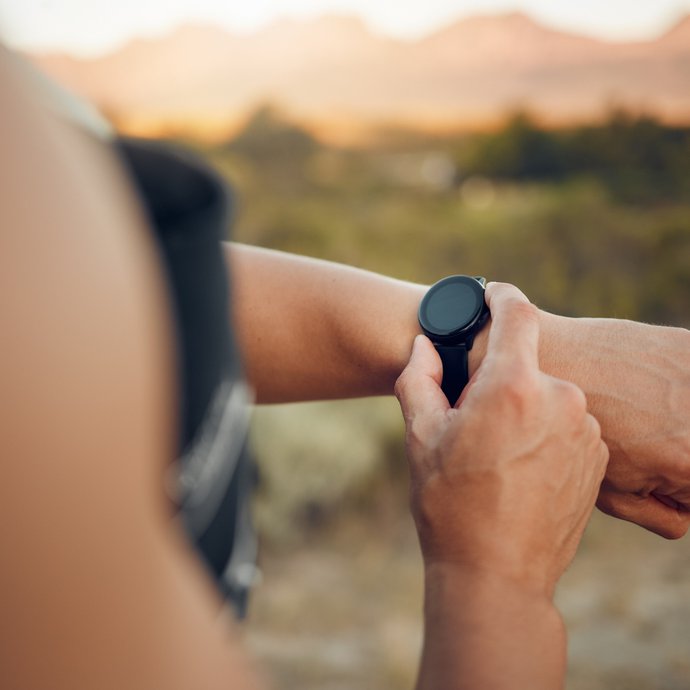
Wearable health tech is one of the biggest fitness trends of 2025 – but why all the buzz?

From Fitbit trackers and step-counting gadgets to the competitive allure of ‘Closing your rings’ (IYKYK), there has been a huge boost in wearable fitness tech in the last few years. Now, however, it’s the turn of wearable health devices, as game-changing – and often life-changing – advancements in technology allow for everything from real-time health tracking to remote patient monitoring. With a growing focus on the design of these gadgets, too – once cumbersome, now stylish and discreet – consumer demand is at an all-time high.
As everyone from Samsung to L’Oréal enters the ring, the question is, what do these gadgets do, are they really beneficial to our wellbeing and what should we be buying?

Here to help, tech expert and CEO/founder of SarahAI, Abrar Siddiqui, decodes the wearable health-tech trend…
Firstly, why is wearable health tech having a moment?
What we’re witnessing in wearable health tech is a paradigm shift in human-AI symbiosis. Our latest neural networks aren’t just processing biometric data – they’re creating unprecedented feedback loops between human physiology and artificial intelligence. The breakthrough isn’t in the sensors themselves, but in how we’re leveraging transformer architectures to decode complex physiological patterns in real-time.
The market surge reflects a deeper transformation: consumers are embracing what I call “ambient intelligence”, where AI seamlessly augments human health decisions through continuous learning and adaptation. We’re moving beyond traditional health metrics into predictive modelling that can forecast physiological changes hours or even days before they manifest.
It seems like business is booming!
Yes, the wearable technology market is experiencing significant growth across various sectors. While fitness-related devices like smart watches and fitness trackers have traditionally dominated the market, there’s a notable shift towards health-driven applications. According to MarketsandMarkets, the wearable healthcare devices market is projected to grow from USD 40.7 billion in 2023 to USD 69.2 billion by 2028.
Talk us through the innovations…
What excites me most is how these systems are evolving from passive monitoring to active optimisation engines. Our latest algorithms can now interpret millions of data points across multiple biomarkers to create personalised health protocols that continuously evolve with each user. This isn’t just health tracking – it’s the beginning of a new era where AI becomes an essential partner in human performance optimisation.
Lastly, what are the benefits of wearable health tech?
I see wearable tech revolutionising health through three key benefits: AI-powered continuous monitoring that catches issues days before symptoms appear, personalised health insights that adapt to individual patterns, and data-driven motivation that transforms daily habits. However, we face important challenges: data privacy concerns given the intimate nature of health information, the risk of over-dependence (our research shows 18% of users experience monitoring anxiety), and the ongoing challenge of consumer-grade accuracy. Success lies in finding the right balance – leveraging these powerful AI capabilities while maintaining appropriate medical oversight. These devices should enhance, not replace, traditional healthcare. Think of them as sophisticated early warning systems that complement your doctor’s expertise.
ABRAR’S TECH TIPS
5 wearable health gadgets worth investing in
Oura Ring Gen4: It has revolutionised the form factor of health wearables – it’s essentially a supercomputer on your finger that uses advanced neural networks to process over 200 biometrics simultaneously. What makes it remarkable is its ability to detect physiological changes up to 72 hours before symptom onset, making it perfect for those seeking continuous health insights without wearing a traditional device.
WHOOP 5.0: It delivers elite-level fitness and recovery tracking through its sophisticated strain-recovery algorithms. Designed for serious athletes and performance optimisers, its standout innovation lies in its AI-powered training recommendations, which adapt to your personal recovery patterns and performance correlations to optimise your training schedule.
Apple Watch Ultra 3: This is the ultimate all-rounded in health tech, combining clinical-grade heart monitoring with comprehensive health features. Its new neural engine elevates it beyond typical smartwatch capabilities, offering medical-grade heart monitoring and advanced sleep analysis. This makes it the ideal choice for those seeking a powerful health companion that doubles as a full-featured smartwatch.
Abbott’s Lingo series: It represents another quantum leap, moving beyond traditional glucose monitoring to analyse ketones, lactate, and even alcohol metabolism in real-time. The breakthrough here is in the AI-driven multimodal sensing technology that can interpret metabolic patterns across different biomarkers simultaneously.
Neuralink Pulse: While not strictly a wearable, this neural interface device represents the next frontier in health monitoring. It’s capable of detecting neural patterns associated with stress, anxiety, and cognitive load in real-time, enabling unprecedented insights into mental health.