



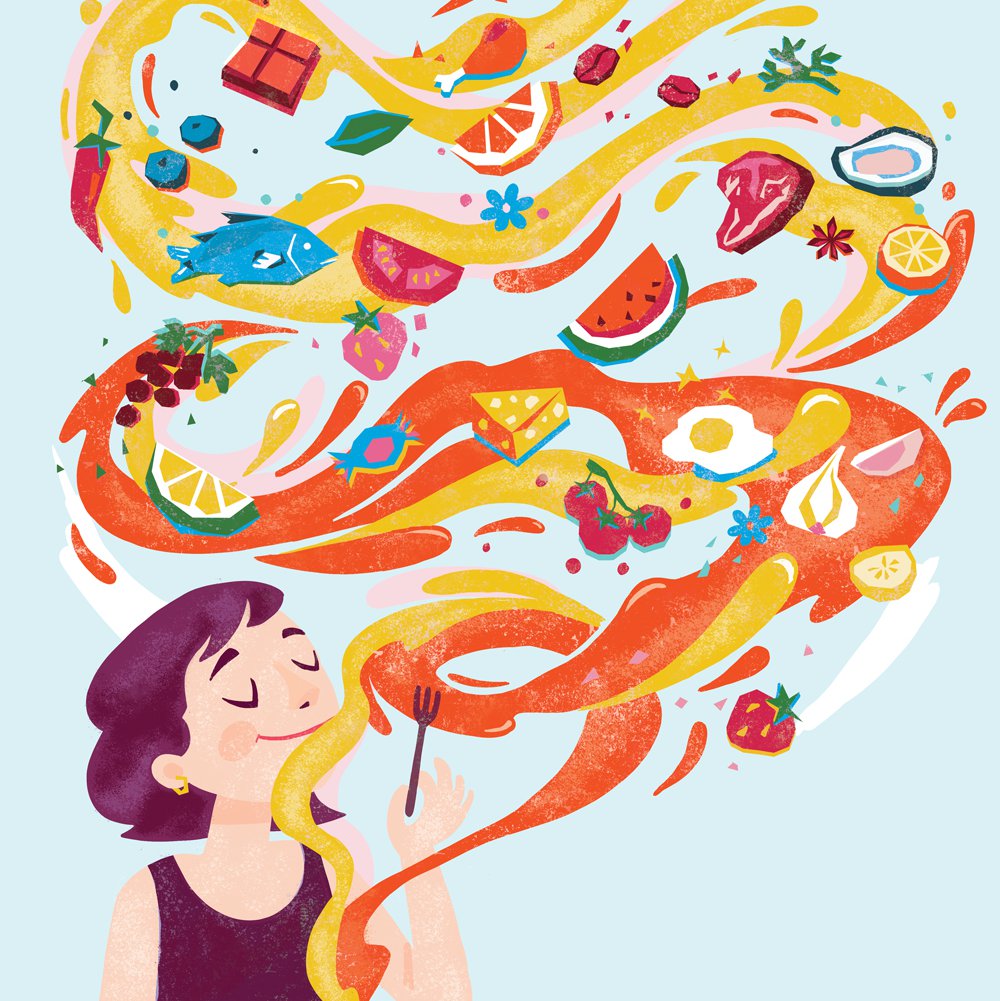
English excels at colour and sound, yet fails at flavour. We uncover how language limits our ability to describe, perceive and truly experience taste and smell

The other day, as I snuck my godchild sweets behind his mother’s back, he popped a sour one into his small mouth. His face immediately scrunched up, eyes full of adorable betrayal, and he spat it out with the word ‘spicy’.
At two-and-a-half, he could be forgiven for confusing the words ‘spicy’ and ‘sour’. After all, both produce similarly sharp sensations. He’s a toddler who doesn’t have quite the right word to describe his taste experience. What he doesn’t yet know is that, as an English speaker, that’s going to be a lifelong problem.
In the hierarchy of the senses, Westerners tend to value vision and hearing most of all, and our language reflects that. English, for example, has a huge and exacting vocabulary to describe what we see – a beautifully ornate, little, old, grey, stainless-steel serving spoon, for example. We have a wealth of onomatopoeia for sound. Instruments can veritably crash, boom, honk, toot and plink away, and English speakers will largely know which is doing which.
The extent to which speakers of a language agree on a word for something – a consensus on a sound, colour or smell – is called ‘codability’. The fact that a musical ‘bang’ makes us all think ‘drum’ denotes high codability, and it’s something English does remarkably well when it comes to sound and vision.
Other languages aren’t quite so comprehensive in these two arenas. Umpila, a critically endangered Aboriginal Australian language, has just three colour words: red (pulpanchi), black (thungku) and white (pulpichi). The remainder of the rainbow is simply unnamed. When Umpila speakers were presented with an 80-shade colour chart in a study by linguist Clair Hill, the vast majority were left unlabelled. Some speakers tried to fill in the gaps using objects from daily life: lips, night-time, flower, shooting star, carpet snake. These are called ‘source-based’ descriptors, and they’re fascinating – beautiful, even – but far from objective.
To English speakers, with their cascade of magenta, teal, crimson, viridian and taupe, having only three colour terms seems unfathomable. It also raises difficult questions, particularly about how little importance the culture places on colour, and how well Umpila speakers even perceive it.
Keep that in mind, then, when we turn to taste and smell, because this is where English starts to give up the linguistic ghost. Much like the Umpila speakers using objects to name colour, English speakers primarily use foods to describe flavours. We call things salty, cheesy, meaty, creamy, lemony, fruity and herbal. What, then, does cream taste like? How about beef? We similarly fall down when it comes to aroma. We don’t have a word for that strong odour fish gives off as it begins to age: it’s simply ‘fishy’.
In a 2017–18 study on linguistic coding of the senses, a team of linguists led by Asifa Majid, Professor of Cognitive Science at the University of Oxford and a leading researcher in language, culture and cognition, investigated how speakers of 20 diverse languages described vision, taste, touch, smell and hearing. English scored spectacularly low when it came to smell and taste codability; conversely, colour-poor Umpila was rated highest for describing smells.
Much like my sweet-toothed godchild, English speakers can’t easily identify what we’re tasting and smelling – and those same questions then arise. Do we value those senses as much as other cultures? And if we can’t even identify them, how well do we really understand and perceive flavour?
A question of taste
Flavour is generally considered a combination of taste and smell. Yes, the look, sound and mouthfeel affect our enjoyment of a meal, but chemically it comes down to the two, and languages love to confuse them.
It’s often touted that smell accounts for around 80% of our flavour experience. There’s no evidence to support this stubborn number, but we do know it plays a large part. Most researchers agree the more intricate dimensions of taste – those meaty, floral, smoky and fruity notes – primarily come from our noses.
“Taste and smell don’t necessarily function in the same way in language,” explains Asifa. “English has basic taste words (e.g. sweet, sour, bitter) but is more limited in smell vocabulary in everyday discourse.”
For example, Farsi, Cantonese and Lao all show high codability for describing tastes, but not smells. Majid points out these languages are spoken in places that place a high cultural value on cuisine. Their dishes are also sophisticated when it comes to balancing aromatics and flavour. In short, it’s possible a highly nuanced, highly valued cuisine results in an equally nuanced language.
English sticks to the five familiar tastes recognised by Western science: sweet, salty, sour, bitter and umami. These aren’t set in stone, however. Umami was accepted into the pantheon only in 1985 and, in 2023, researchers reported evidence suggesting a possible sixth taste – the rather less catchy ammonium chloride.
Other languages have far more building blocks in their taste lexicon. Take Lao, the highest rated for taste codability in Majid’s study. Alongside the five basic tastes, Lao has seven ‘flavour’ words encompassing textural and sensation dimensions. In a 2011 paper, Nicholas Enfield found Laotians reliably identified caang (not salty enough, bland), hùn (hot, minty), khùùn (biting, tingly), faat (chalky, dry in the mouth), phêt (spicy, hot), man (oily, starchy, rich) and khêt (causing a so-called ‘itch in the teeth’ from certain sour foods).
English speakers do have their own abstract flavour words – those created to ‘capture’ the property, like astringent – but they’re uncommon and used with far less consensus. We simply don’t have a single term for other flavours. Faat, for example, is an everyday flavour in Laos; in English, we might describe it as the flavour of unripe bananas.
What’s really interesting about Nicholas’ research is how Lao speakers discern these flavours. He recounts hearing them use abstract terms like caang (not salty enough, bland) to describe foods he found ‘so overwhelmingly spicy’ he couldn’t distinguish any component flavours. Even if he had the words, he didn’t have the ability to detect them.
The further down this linguistic rabbit hole you go, the more it starts to feel like a chicken-and-egg situation (both, one imagines, easily described as caang). Do I not have the words because I can’t taste the flavour, or can I not taste the flavour because I don’t have the words?

Scent and sensibility
Although there are outliers, generally smell is poorly coded across the linguistic board. Of all the senses studied by Asifa et al., smell was the most likely to have ‘evaluative’ descriptions: nice, horrid, pleasant. Its interpretation is far less objective, more subjective.
The science behind olfactory flavours is rich, dizzying and rather fun, but at a basic level we perceive smells in two ways, depending on airflow. Think of it as preceding eating (inhale), or accompanying it (exhale).
That inhaled smell is called orthonasal, coming from the bouquet of aromas on the air – the earthy nut and berry notes of brewing coffee, the resinous sweetness of pine, the warm toastiness of freshly baked bread.
Retronasal smell is when aromas from the mouth travel into your nasal cavity via your throat: an astonishingly unattractive way to describe the miracle of flavour. It’s where most of that supposed ‘80%’ lies. It’s what molecular chefs experiment with, combining dissonant tastes, textures and retronasal aromatics to create flavour blends.
However bad English speakers are at identifying taste, we’re far worse at aromas. You only need watch a perfume advert, or read scented candle names (‘Nature’s Paintbrush’ or ‘Sparkling Snow’ anyone?), to see how truly abysmal we are.
Humans can differentiate some 1 trillion smells, but English can name only a relative handful. Even wine and coffee experts struggle to describe smells outside their remit.
Plenty of languages outstrip English for smell codability, and some appear to have a direct cultural link. The same happens with sound; it’s hardly surprising that musical societies are much better at describing sound than non-musical ones. Asifa and her team found the coding crown belongs to languages from hunter-gatherer communities, for whom smell is a vital part of everyday life and ritual.
The best examples are found around the Malaysian-Thai border. Asifa formed half of each team studying Malaysia’s Jahai and Thailand’s Maniq people. The research found that Malaysia’s rainforest-dwelling Jahai can describe colours and odours with the same level of specificity, while the Maniq have 15 basic abstract smell terms – the largest number yet discovered.
Both languages show astounding abilities to define smells: the Maniq have words for the smell of the sun, millipedes, snakes and old shelters. The Jahai have a term for ‘a bloody smell that attracts tigers’, another for ‘a stinging smell’ like petrol, smoke or wild ginger.
Western scientists long assumed smell was universally difficult to describe. Back in 1916, psychologist Hans Henning even said that “olfactory abstraction is impossible”: no one could describe smell in the same way as colour. It turns out it wasn’t a limitation of language, but a limitation of our language. We just needed to think, and smell, outside our box.

A new word order
English certainly didn’t become a global lingua franca because it was the best at everything. Though it’s now spoken worldwide, it’s easy to forget it comes with cultural values, including how we think about the senses, baked in.
Some languages have suffered from this. Research has shown Cantonese taste categories have deteriorated with increased exposure to Western society, while its colour/shape lexicon has expanded. Others have benefitted; Kilivila, from Papua New Guinea’s Trobriand Islands (the kind of colourful, tropical idyll the English language dreams of), has gained colour terms without losing taste in return.
Can English similarly learn and adopt values from other languages? The internet has made language dissemination relatively easy, and recent fascination with untranslatable foreign words has introduced us to Danish hygge, German fernweh and Japanese kuchisabishii, among others. The term for the smell, petrichor, was coined only in 1964, and umami was once a stranger to English speakers; now it peppers restaurant reviews, menus and food blogs.
“When there is a lexical gap in a language, and the community develops a need to communicate about that concept, a new term can be coined or borrowed,” explains Asifa. “The main thing is that there has to be a communicative need to talk about that thing.”
As our palates grow accustomed to cuisines from myriad cultures, to flavours we’ve never been exposed to before, there’s always the possibility our vocabulary could grow alongside. Surely even highly codable words had to start somewhere, and with new linguistic research and the internet ready to provide them, the world – and its word – is our oyster.